blog
Money Loves Speed: How Removing Friction Creates Millions in New Value

Glen Carlson
Cofounder, Dent

Money loves speed.
Put yourself in your customer’s shoes. They don’t want to do anything at all to get the outcome they want.
Magic wand, they’ve just got it.
Anything short of that is friction. And the more friction they have to push through, the more of them bounce out and buy somewhere else.
In this article I’ll share the tool we use to find the exact points where that’s happening in your business, and how to turn each one into an asset that pays you back for years — and how we used it to create an 8 figure tech startup.
If you want more profit, less complexity and the luxury of surplus time, you need a friction list.
Consider the ideas of friction and speed now from your perspective. The purpose of your business is to create leverage: the minimum you can put in — time, team and capital — to get the maximum out for your clients, shareholders and yourself.
The problem is there’s too much to do
Too many options, too many moving parts, too many fires to put out, competing priorities everywhere. An infinite number of things you could do.
And yet there are probably only two or three major problems in your business that, solved, would change your business — and life.
They’re hard to get to because we follow the path of least resistance. Deciding what to focus on is hard, so we avoid it and fill the week with work we already know how to do, even when that work is just high-performance procrastination.
Every stress, frustration and bottleneck — friction — traces back to an asset deficiency.
Something is missing in your business. Wherever you lack a key strategic asset, you’re forced to compensate with your time, your money or your emotional energy. Finding the problems worth your attention means finding the friction, then finding the missing asset upstream.
An asset is work done once that keeps working
That’s the shortest version. The full definition has two halves. The first: it replaces human labour. The second: its value compounds. You build it once, and it keeps doing the job without you, year after year.
An ‘about us’ video becomes an asset the day it stops you having to explain yourself to every new person you meet.
A landing page becomes an asset the day it brings in leads while you’re doing something else.
A respected award shortens the time to a sale because it carries trust faster than more meetings can.
An agent that reads your meeting transcripts and pulls out the insights you keep sharing in your own words.
There’s no end to this list, but you get the idea: effort once, value on repeat.
Sales, the easiest place to see it
In sales, the job is to take someone from not knowing who you are to paying a premium to work with you. At one edge, you sit in front of a stranger with nothing. At the other, you hand them exactly what they need at every step of their decision, all the way to purchase.
Your business sits somewhere between those two edges. Where, exactly, is worth working out before you build anything.
What do you build first?
Most people run it back to front. They read books and scroll through social media and end up with a massive list of prescribed stuff to build. Without an organising principle, it’s easy to go in whatever order feels busy.
An asset is only worth the friction it removes. An asset that removes none has the opposite effect: now you’ve got another thing to orchestrate, promote and maintain that you didn’t need in the first place.
Friction shows up in two places, and only two
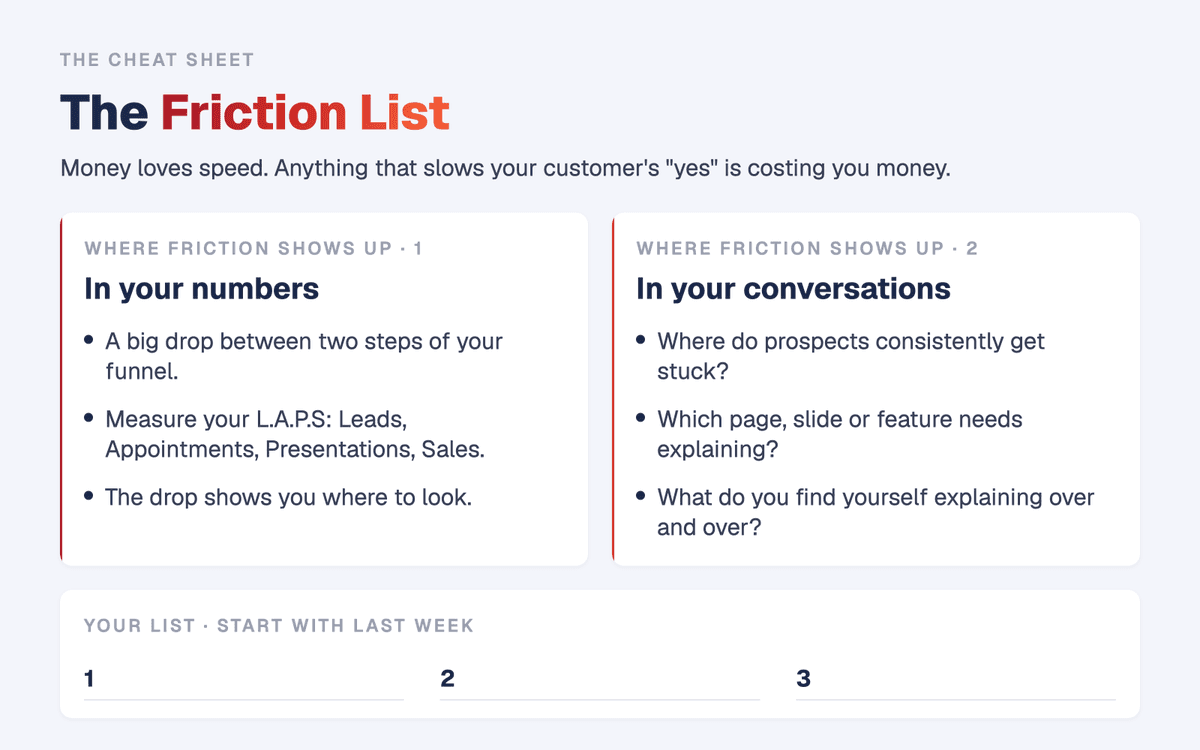
In your numbers. A big drop between leads and appointments, or between presentations and sales, is friction you can see in data. Measure your L.A.P.S. — Leads, Appointments, Presentations and Sales — and the drop shows you where to look.
In your conversations. Are prospects consistently getting stuck at the same point? Do they struggle with a particular page, slide, feature or offer? Do you find yourself explaining the same thing over and over? These are all signs of friction.
The thing you keep having to explain on every call is the next asset to build.
The friction list is how you make this a habit
Start the list. Write down every point a prospect got stuck, hesitated or went cold.
Postmortem every sales conversation. Debrief after every call: what was the friction, what worked and what didn’t?
Turn recurring friction into assets. Build the small piece that answers the repeated question or removes the repeated snag.
Embed it in your repeatable week. Ask ‘where was the friction this week?’ on schedule.
Sales was only the example
Now zoom back out. Hiring, data, AI and agents all use the same questions: What’s the friction? What’s the stress, frustration or bottleneck? What asset is missing? Is this worth my attention, or is there something bigger?
Sometimes the missing asset is a whole business
Five years ago, we kept hitting the same friction on sales calls. To find the real problem, a salesperson had to ask a huge number of pointed questions, and the first call often ran so long it took a second call to finish the job.
The blue-sky answer was to get the prospect to fill in a survey first, so the salesperson walks in already knowing every pain point. But nobody would fill in a survey that gave nothing back. The refusal was friction too.
So we created a tool that read the answers and handed the person insights about their own business instantly. That idea became ScoreApp. Today it turns over six million a year, has more than 10,000 users and sits somewhere between thirty and sixty million in value.
One point of friction on a sales call, walked through the same two questions, and out came a company.
So what’s the right structure?
There’s no perfect structure, and I’d distrust anyone selling you one. Business architecture is like sailing: you need to change your sails to meet the conditions. The market isn’t static; it’s dynamic.
The structure matters less than your ability to notice where the friction sits right now. The friction list is the forcing function for that ability.
First principles, one more time
Money loves speed. Your customer wants the outcome with the least effort possible. The purpose of your business is leverage: the minimum in, for the maximum out. Friction is where both break down, and every piece of friction points at a missing asset.
Find the two or three that matter, build those assets, and let the rest wait.
P.S. Start the list today. Open a note, title it ‘Friction’, and write down the last place a prospect stalled, or the last thing your team had to work around. That’s the whole setup.